Filtering by Category: Public Square

  •   Public Square   •  

A Statement From Dr. Joel C. Hunter on Today's Supreme Court Decision Regarding Gay Marriage

For most people, including the church, today’s Supreme Court decision is no surprise. But we must not confuse the roles of church and state. It is the responsibility of civil government to defend the rights of all its citizens, and to define civil marriage; it is the responsibility of a religious group to interpret its scriptures and act accordingly, including defining the parties and parameters of holy matrimony.

Ultimately, it is our joy as a church is to welcome everyone seeking a closer relationship with God, no matter what their marital status or views on various issues.

— Dr. Joel C. Hunter

View Post

  •   Public Square   •  

Oh come all ye faithful?

Oh come all ye faithful? Oh come all ye faithful? Obama rarely seen in church, but advisers say his beliefs remain strong.

President Barack Obama rarely goes to church and has spent just one Christmas morning of his presidency in the pews.

But that’s not for lack of faith, members of his small circle of religious confidants say. While church isn’t a regular part of Obama’s life, prayer and reflection are, whether he’s meeting with ministers in the Oval Office or spending a few minutes reading an inspirational passage. And, if anything, they argue, his connection with God has intensified during his time in the White House.

“The president’s faith has deepened in the second term; he’s said as much,” said Joshua DuBois, a longtime spiritual adviser to Obama who led the White House Office of Faith-based and Neighborhood Partnerships during the president’s first term.

“The president’s Christian faith is not connected to or dependent upon anyone else’s beliefs about him, any particular policy issue, any moment in the news cycle or anything else,” DuBois said. “The president’s faith existed long before the While House and will continue after he closes the door to the White House for the last time.”

Critics say that wouldn’t be readily apparent from watching his public comings and goings. After disavowing his former pastor, Jeremiah Wright, and leaving Wright’s Chicago church during the 2008 campaign, Obama was widely expected to seek out a church in Washington that he’d attend with some frequency. Instead, he’s attended Sunday services only occasionally, visiting a patchwork of congregations 19 times in all since taking office, according to a POLITICO analysis of White House pool reports.

But the president embraces his faith in other ways, people who see this private side of him say.

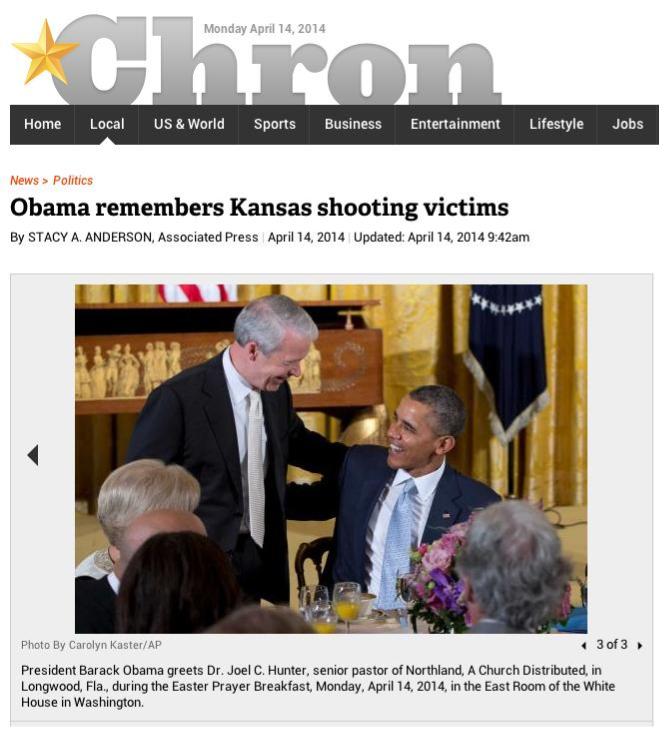
DuBois, an ordained Pentecostal minister, and Joel Hunter, a Florida megachurch pastor, are Obama’s two closest religious advisers. A larger circle — which includes evangelical activist Jim Wallis and civil rights movement leader Joseph Lowery, among others — marks the president’s birthday each year, and many in the same group attend the Easter Prayer Breakfast and other White House events throughout the year.

Keeping up a practice that DuBois began during the 2008 campaign, they also send Obama daily devotionals — prayers, poems and other messages — that he reads on his BlackBerry.

“Reading scripture every day yields a certain amount of personal growth, and he’s done this every day for years,” Hunter said. At prayer breakfasts and other gatherings, Hunter has seen “a man who really enjoys talking about his faith” and who “seems at home.”

“It’s a good indication that he is growing in his faith,” he added.

Though Obama rarely discusses his faith, he has made clear that, if nothing else, being president has made him more attentive to it.

“I’m far more mindful of my own failings, knowing exactly what [Abraham] Lincoln meant when he said, ‘I have been driven to my knees many times by the overwhelming conviction that I had no place else to go,’” he said at the 2012 Democratic National Convention, drawing on a quotation attributed to the 16th president, though Lincoln may not have actually said it.

“The pressures of the office tend to lead presidents toward prayer. Those who have a reservoir of piety and theological understanding will draw on that, dip into that,” said Randall Balmer, a professor of religion at Dartmouth College and author of “God in the White House: How Faith Shaped the Presidency from John F. Kennedy to George W. Bush.”

Jimmy Carter, for one, would pray several times each day while in office, sometimes whispering to himself between meetings, Balmer said.

Early on in his term, Obama’s spiritual focus was on being the best possible president, Hunter said, but over the past few years he’s broadened his perspective, thinking more of his role not just as commander in chief but as a father and as a man.

“He has more paid attention to who he needs to be as a man and who other people need him to be as a person who is always trying to do the right thing but will always be blocked politically,” Hunter said.

“You never give up, you always try for political solutions, but you become increasingly aware … there isn’t a killer app, there’s not gonna be a huge move,” he added. “When problems get solved, they’re gonna be incremental, simply because that’s the only way things are being done these days in Washington.”

In addition to spending time reading and mulling over his daily devotionals, Obama occasionally talks by phone or meets in person with his spiritual advisers. There’s no formal schedule to when these conversations take place, just whenever the president wants them, advisers said.

“Every time we pray, I’ll ask him, ‘What do you want to pray for?’ And he says, ‘Well, let’s pray for the country,’” Hunter said. “The country is so on his mind. It’s not, ‘Let’s pray just for this group or just for this cause,’ it’s, ‘I want to pray for the country.’ That’s encouraging to see.”

In all, Obama has gone to services on about 6 percent of the Sundays of his presidency and just once on Christmas Day, in 2011, which also happened to be a Sunday. George W. Bush, by contrast, went to church on close to 30 percent of Sundays during his eight years in office.

All of this stokes criticism on the right, with some arguing that Obama’s professed Christian faith is a sham — or at least an overstatement — meant to make him more palatable to voters.

In an interview last fall, Fox News host Bill O’Reilly pushed DuBois on why the president “doesn’t go to church more often” and wondered whether there was any link between Obama’s departure from Wright’s church and the infrequency of his public worship. DuBois defended the president, saying Obama “leads with his relationship with Jesus” and goes to church several times a year.

One factor is that the first family is busy and prefers to use its free time to bond together at home.

“We try to go to church as much as possible, but when the kids get older, you know, Sunday is some kind of practice, rehearsal, birthday party, you know. So getting us all together on a Sunday is becoming more difficult now that the girls are getting older,” first lady Michelle Obama said in an interview on “Live with Kelly and Michael” timed to the annual White House Easter Egg Roll this year.

“But if we’re not going to church, we really try to use Sunday as family downtime where we can kind of breathe and catch up and maybe take a little nap every now and then if we’re not working,” she said.

But the key reason the president doesn’t go to church more often, DuBois and others close to him said, is because he worries that his presence detracts from other worshipers’ experience.

Obama found out how difficult it would be for him to go to church before he even became president, when he and his family were swarmed by well-wishers and photo-takers at Washington’s Nineteenth Street Baptist Church, one of the nation’s oldest black churches, on the Sunday before his 2009 inauguration.

“When folks see the line forming outside, a lot of folks who don’t attend that congregation go in,” DuBois said. “It displaces a lot of people who are members of that church or at least interrupts them.”

More than five years later, on Easter Sunday this year, the crowd at Nineteenth Street Baptist — located 3 1/2 miles up 16th Street from the White House — was enthusiastic but not overwhelmed by the Obamas’ presence. Still, the first family faced several minutes of what a reporter described as “crowd crush,” with worshipers jockeying for position as they pulled out their smartphones and tablets.

During the president’s Easter visit to the church — his only one so far this year — senior pastor Derrick Harkins acknowledged the first family’s arrival and offered prayers for them, asking that God give the president “every measure of encouragement” and “wisdom.” He also called on God to “tend to his spirit” under the weight of criticism.

After the first flurry of attention, the congregation was respectful, Harkins said. “Our members have wanted to make sure that the worship experience is one that is meaningful and supportive of [the president] and his family” and not one that overwhelms them.

And the Obamas appreciate it. “The president and the first lady are never hesitant to share that they found the worship time valuable to them,” Harkins said. “It’s absolutely genuine.”

To those who doubt Obama’s dedication to his faith, Harkins, a former adviser to the Democratic National Committee, added: “If we were to judge spiritual depth and fulfillment based on who went to church and who didn’t, there would probably be a lot of surprises. I never try to determine what the spiritual engagement of another person is. It’s an awfully pretentious thing to do about anybody, let alone the president.”

SOURCE: http://www.politico.com/story/2014/12/president-barack-obama-religion-113791.html
View Post

  •   Interfaith Dialogue, Public Square   •  

Orlando Sentinel: Interfaith prayer service honors Joel Hunter

Interfaith prayer service honors Joel Hunter

One by one, members of different faiths and beliefs stepped forward Tuesday night to light candles in remembrance of loved ones they had lost.

In the procession of Christians, Muslims, Jews, Hindus and Buddhists, Northland Church Pastor Joel Hunter and his wife Becky lit a candle for their son, Isaac Hunter.

In the end, some 70 candles flickered in a small sanctuary of the St. James Catholic Cathedral in downtown Orlando during the hour-long Interfaith Prayer Service for Peace.

"Many of us faced losses this past year or unresolved losses," said Rev. Bryan Fulwider, a Congregational minister. "We are strengthened, we are healed, by standing together, walking together, being together."

Leaders of the major religions as well as representatives of the Sikh, Unitarian and Baha'i faiths, also said prayers.

The service was both an act of empathy for all who lost friends and relatives and a public show of support for Hunter, whose son died by suicide in December.

"This is a service designed to bring comfort to all that have had losses, but it's also a collective embrace of him and his family for their loss of Isaac," said Pastor James Coffin, executive director of the Interfaith Council of Central Florida.

Coffin said the idea of focusing on personal peace following a private tragedy came from Orlando Catholic Diocese Bishop John Noonan, who started the annual interfaith prayer service about three years ago.

Hunter is widely respected within the faith community for his commitment to building relationships with leaders of different religions.

One of his longest friendships is with Imam Muhammad Musri, president of the Islamic Society of Central Florida.

"He is an evangelical leader who got a lot of flak for going out and meeting with Muslims and other communities," said Musri, who sat beside Hunter.

"The least we can do is be with him and lift up his spirit."

That willingness to join in with other religions might have cost Hunter friends among evangelicals, but his commitment to interfaith cooperation is the natural extension of his Christian faith, said Fulwider, president of Building US, a nonprofit diversity consulting and training organization.

"He has become a friend to those in other faith communities because this is who Jesus calls him to be," Fulwider said.

"He is not a person who cuts off relations because you have a difference of understanding or belief or thoughts. To me that is the heart of the Christian gospel."

[email protected] or 407-420-5392.

SOURCE: http://articles.orlandosentinel.com/2014-01-14/news/os-joel-hunter-peace-prayer-20140114_1_isaac-hunter-joel-hunter-interfaith-council

View Post

  •   Public Square   •  

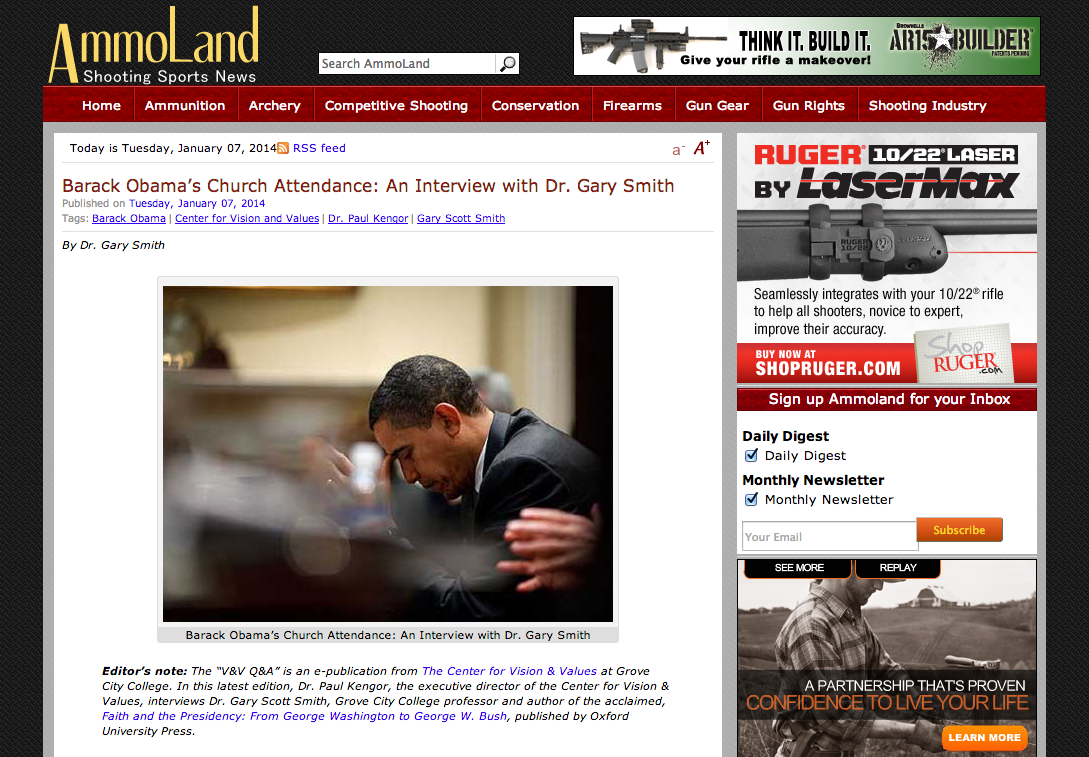
Barack Obama’s Church Attendance: An Interview with Dr. Gary Smith

Screen Shot 2014-01-07 at 1.20.34 PM Editor’s note: The “V&V Q&A” is an e-publication from The Center for Vision & Values at Grove City College. In this latest edition, Dr. Paul Kengor, the executive director of the Center for Vision & Values, interviews Dr. Gary Scott Smith, Grove City College professor and author of the acclaimed, Faith and the Presidency: From George Washington to George W. Bush, published by Oxford University Press.
Kengor: Dr. Smith, you are one of the country’s leading experts on faith and the presidency. Reporters frequently come to you for comment. In that spirit, the New York Times interviewed you last week on the notable fact that President Obama didn’t attend religious services this past Christmas. That’s quite unusual for a president, isn’t it?

Smith: Yes, it is.

Kengor: Do you know of any other president skipping religious services at Christmas?

Smith: Some probably did not attend religious services at Christmas, but I do not know of any specifically. The media was not omnipresent before the 1960s, so it was easier for presidents’ non-attendance to go unnoticed. However, most presidents have attended church faithfully while in office, including George Washington, John Adams, John Quincy Adams, Andrew Jackson, Abraham Lincoln, William McKinley, Theodore Roosevelt, Woodrow Wilson, Dwight Eisenhower, John F. Kennedy, Jimmy Carter, and Bill Clinton. Others who claimed to have a strong Christian faith but attended infrequently while president include Franklin Roosevelt, Harry Truman, and Ronald Reagan. Obama did issue a Christmas message, as he has done every year as president, in which he encouraged Americans to serve others. “For families like ours,” he declared, “that service is a chance to celebrate the birth of Christ and live out what He taught us—to love our neighbors as we would ourselves; to feed the hungry and look after the sick; to be our brother’s keeper.” Obama has used this latter phrase more than 60 times in his presidential addresses and proclamations.

Kengor: Yes, he uses that phrase constantly. Did President Obama give a rationale for not attending church this Christmas? What’s the explanation?

Smith: He apparently has not offered an explanation for not attending Christmas services. He did vacation in Hawaii for five days where he spent time with his family, played golf three times, attended a basketball game, and visited a military base. On Christmas Eve, the president called U.S. armed forces members who are stationed around the globe to wish them a Merry Christmas.

Kengor: Moving away from this Christmas example, what about Obama’s attendance at church generally? The New York Times quotes an “unofficial White House historian” who calculates that Obama has attended church 18 times during his nearly five years in the White House, while his predecessor, George W. Bush, attended 120 times during his eight years in office. Is Obama a member of a church?

Smith: Obama does not currently belong to any congregation. After attending St. John’s Episcopal Church and 19th Street Baptist Church in Washington a few times, he decided instead to worship primarily at the Evergreen Chapel at Camp David. However, he rarely spends weekends at Camp David.

Kengor: Does Obama have a formal religious affiliation? He’s no longer with the denomination that housed Rev. Jeremiah Wright’s church, is he?

Smith: Since ending his relationship with Wright’s Trinity United Church of Christ Church in Chicago during the 2008 campaign, Obama has not joined a church.

Kengor: Has Obama explained his lack of church attendance? You and I both have written on President Ronald Reagan’s faith. Reagan stopped attending church regularly after the assassination attempt, though (to my knowledge) he always attended Christmas and Easter services. Reagan gave a host of reasons for his infrequent attendance as president. (He returned to church regularly again after the presidency.) Has Obama addressed this? Reagan was constantly asked to address it, and did.

Smith: Obama has seldom commented on why he rarely attends church. His basic explanation is that he dislikes being on display when he worships (many people have snapped pictures of him with their cell phones and some pastors have spoken directly to him).

Kengor: In the Times article, you’re quoted as saying, “I would argue that Obama’s faith has been one of the most misunderstood of any president.” What do you mean by that?

Smith: From 2008 until now, many Americans (as high as 20 percent in some polls) have identified Obama as a Muslim despite the controversy over his membership in Wright’s church and his many professions of Christian faith. Because of his connection with Wright, others have labeled him an advocate of black liberation theology. Many political and religious conservatives complain that Obama’s claim to be a Christian is disingenuous and entirely politically motivated. Obama has been labeled “the most explicitly Christian president in American history” by historian John Fea and America’s “Most Biblically Hostile” president by evangelical author and activist David Barton. Many conservative Christian books and websites argue that Obama is trying to destroy the nation’s Christian heritage and cannot possibly be a Christian because of his stances on abortion, gay marriage, and government redistribution of wealth. On the other hand, liberal Protestants and Catholics and some evangelicals praise Obama’s concern for aiding the marginalized, oppressed, and poor. Some younger evangelicals support Obama because of his commitment to social-justice issues like overcoming racism, combating poverty, and tackling global issues like AIDS.

Kengor: As you note, conservatives who don’t like Obama argue that his faith is not genuine, while liberals who do like Obama argue otherwise. Others take a position somewhere in between. What’s your take?

Smith: I believe that Obama’s faith is genuine. He has testified to it many times on both the campaign trail, at National Prayer Breakfasts, and in other settings. Obama has repeatedly declared that Jesus is his savior and Lord and that he bases his life on Christ’s teachings. He has frequently affirmed his belief in Christ’s divinity, bodily resurrection, and atoning death on the cross. Obama insists that he prays and reads the Bible regularly. He meets and prays regularly with ministers of various denominations and theological traditions. Evangelical pastor Joel Hunter, Obama’s closest spiritual mentor, asserts that the president is “born again” and “has trusted in Jesus Christ with his whole heart.”

Obama’s faith is difficult to decipher, however, because various streams—the African-American church, the Social Gospel movement, mainline Protestantism, and evangelicalism—have all shaped it. On the other hand, as Stephen Mansfield contends, Obama’s “big-tent approach” to religion and spirituality “is perfectly in step with the country he now leads.” Like the vast majority of Americans, he believes that many paths lead to God and that all religions contain fundamentals truths. Similarly, New York Times columnist Ross Douthat asserts that Obama embodies America’s “uncentered spiritual landscape” because like 44 percent of Americans, the president switched his religion as an adult, and because he is part of one of America’s fastest-growing religious constituencies—the “unchurched Christian” bloc.

Kengor: Dr. Smith, thanks for your time. I strongly encourage readers to pick up a copy of your outstanding book on faith and the presidency.

Smith: My pleasure.

Dr. Gary Scott Smith chairs the history department at Grove City College and is a fellow for faith and the presidency with The Center for Vision & Values. He is the author of “Faith and the Presidency From George Washington to George W. Bush” (Oxford University Press, 2009) and “Heaven in the American Imagination” (Oxford University Press, 2011).

SOURCE: http://www.ammoland.com/2014/01/barack-obamas-church-attendance-an-interview-with-dr-gary-smith/#axzz2pjmtCxYU

View Post

  •   Public Square   •  

Son of “Orlando’s Favorite Pastor” Named “Orlando's Best Eye Surgeon”

Father and son honored by readers of Orlando Business Journal and Orlando magazine.

ORLANDO, Fla. (OCT. 18, 2013) — Like father like son … readers of Orlando Business Journal have named the son and namesake of nationally known pastor Rev. Joel C. Hunter as “.” Rev. Hunter was recently honored as “Orlando’s Favorite Pastor” by Orlando magazine.

Joel Hunter, M.D. opened the area’s most-advanced LASIK facility back in 2010 at the RDV Sportsplex—offering state-of-the art, bladeless laser vision correction and laser cataract surgery. This year, Hunter Vision expanded its services to include general eye care.

As a distinguished fellow at the most prestigious refractive surgery center in the world, Dr. Hunter had his choice of jobs, but chose instead to create a new and better kind of medical practice in his hometown of Orlando.

Using a new generation of diagnostic and surgical equipment, Dr. Hunter is able to perform some of the finest and most-precise vision correction procedures in the field, including 3D LASIK and laser cataract surgery—a procedure he is helping to pioneer at Hunter Vision.

Dr. Hunter concludes, “My family has been grateful to serve the central Florida community for nearly 30 years. Hunter Vision is committed to continuing that tradition.”

View Post

  •   Public Square   •  

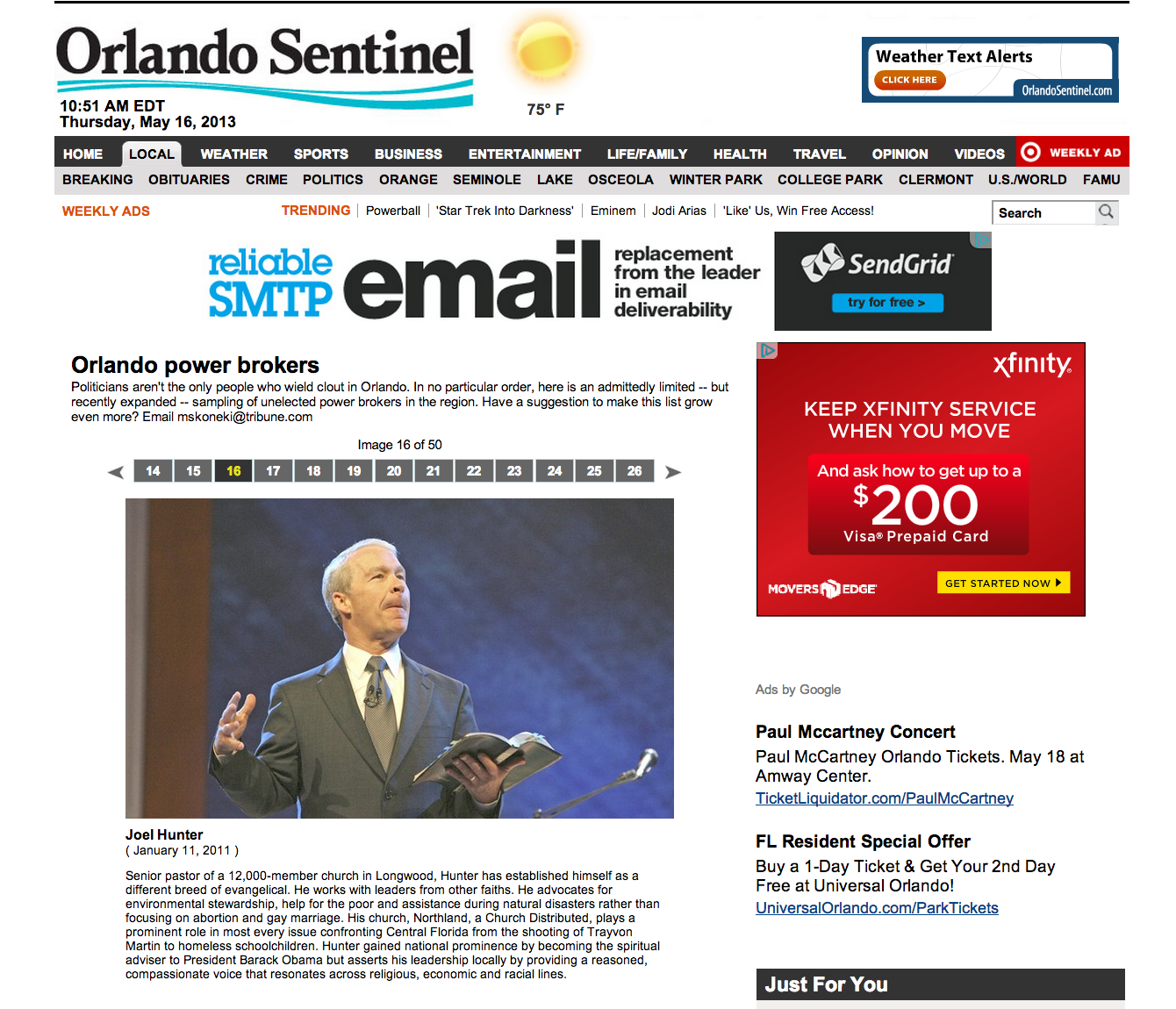
Orlando Sentinel: Dr. Joel C. Hunter Is a "Different Breed of Evangelical"

Screen Shot 2013-05-16 at 10.52.28 AM The paper reports: "Hunter has established himself as a different breed of evangelical. He works with leaders from other faiths. He advocates for environmental stewardship, help for the poor and assistance during natural disasters rather than focusing on abortion and gay marriage. His church, Northland, a Church Distributed, plays a prominent role in most every issue confronting Central Florida from the shooting of Trayvon Martin to homeless schoolchildren. Hunter gained national prominence by becoming the spiritual adviser to President Barack Obama but asserts his leadership locally by providing a reasoned, compassionate voice that resonates across religious, economic and racial lines." View the Sentinel's complete list of "Orlando's Power Brokers."
View Post

  •   Public Square   •  

White House Names New Faith-Based Office Director

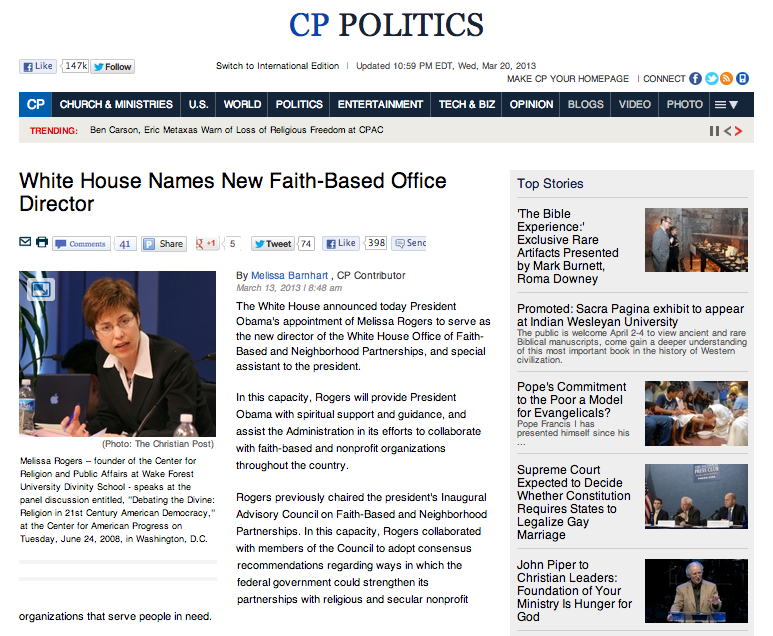
Screen Shot 2013-03-20 at 10.59.29 PM The White House announced today President Obama's appointment of Melissa Rogers to serve as the new director of the White House Office of Faith-Based and Neighborhood Partnerships, and special assistant to the president.

In this capacity, Rogers will provide President Obama with spiritual support and guidance, and assist the Administration in its efforts to collaborate with faith-based and nonprofit organizations throughout the country.

Rogers previously chaired the president's Inaugural Advisory Council on Faith-Based and Neighborhood Partnerships. In this capacity, Rogers collaborated with members of the Council to adopt consensus recommendations regarding ways in which the federal government could strengthen its partnerships with religious and secular nonprofit organizations that serve people in need.

Joel Hunter, senior pastor of Northland, A Church Distributed in Florida and who was a member of President Obama's inaugural Advisory Council on Faith-Based and Neighborhood Partnerships, said of Rogers, "She worked diligently [as Council chair] to find common ground. Melissa has a gift for crafting the kind of language that maintains clear boundaries but promotes cooperation."

He continued, "I may differ with Rogers on certain policy and legal issues but I have faith that she will always listen to a variety of views and make sure they are accurately conveyed.

"Melissa is an honest broker, a consensus-builder, and a problem-solver, and someone who believes that government should be actively engaged with civil society, including religious institutions and individuals, to promote the common good. I look forward to her service in the White House."

In 2010, Obama issued an executive order that embraced the council's recommendations, and one of Rogers' tasks will be to implement that order across a range of federally funded programs.

Rogers, who is known for reaching across ideological, political and religious lines to gain consensus on collaborative projects to promote the common good, recently led a common ground project that resulted in the publication of Religious Expression in American Public Life: A Joint Statement of Current Law.

This consensus statement was drafted by a diverse group of religious and civil liberties leaders on the state of current law: signatories included staff from Pat Robertson's American Center for Law and Justice to former staff of the American Civil Liberties Union.

Rogers also collaborated with religious and political leaders in a project called Come Let Us Reason, in which a group of Christian evangelicals and political progressives sought and found important common ground on issues, such as non­discrimination, ending torture, reducing the number of abortions, and reforming our immigration system.

In February, Obama announced Joshua DuBois' departure as head of the White House Office of Faith Based and Neighborhood Partnerships, a position he held since 2009.

During his speech at the National Prayer Breakfast in Washington, D.C., Obama thanked DuBois for his stewardship and service to him during the past four years. "This morning, I want to publicly thank Joshua for all that he's done, and I know that everybody joins me in wishing him all the best in his future endeavors – including getting married," Obama said.

The president also thanked the 30-year-old aide for sending him a daily devotional every morning via email, "a snippet of Scripture for me to reflect on." Obama added that, "it has meant the world to me."

DuBois, who's credited with helping the Democrats establish a progressive faith movement, was 26 when he started working for the Obama presidential campaign. He now teaches at New York University and plans to author a book of devotionals for leaders, based on the ones he sent the president each day.

The Pentecostal minister sparked controversy last year when he defended the Health and Human Services (HHS) mandate that would require all insurance companies to supply contraceptives and abortifacients, even to employees who work for religious institutions and organizations that are opposed to both.

However, he was also a staunch defender of Pastor Louie Giglio, who was scheduled to deliver the benediction at Obama's inauguration, but whose appearance was canceled by the Inauguration Committee after a decade old sermon delivered by the pastor surfaced, in which he stated the biblical view of homosexuality.

Prior to working for Obama as a senate aide and then the religious affairs director for the Obama campaign, DuBois worked for Democratic Rep. Charles Rangel (D-N.Y.), was a fellow for former Congressman Charles Holt (D-N.J.), and served as an associate pastor for a small Pentecostal church in Massachusetts.

DuBois said in a statement regarding his successor, "I have known Melissa Rogers for years, as chair of President Obama's faith-based advisory council, as one of the nation's leading experts on religion and public life, and as a close and dear friend. There is no better person to lead the White House Office of Faith-Based and Neighborhood Partnerships, and bring the federal government into deeper, effective and constitutional partnership with faith-based and other nonprofit groups around the country."

The White House Office of Faith-Based and Neighborhood Partnerships (formerly the White House Office of Faith-Based and Community Initiatives) was established in 2001 by former President George W. Bush, who used his first executive order to create the initiative, which was established with the aim of increasing government-funded social service grants to faith-based organizations that are improving the lives of those who live in their communities.

By Melissa Barnhart, Christian Post. Find this article at: http://www.christianpost.com/news/white-house-names-new-faith-based-office-director-91781/

View Post

  •   Public Square   •  

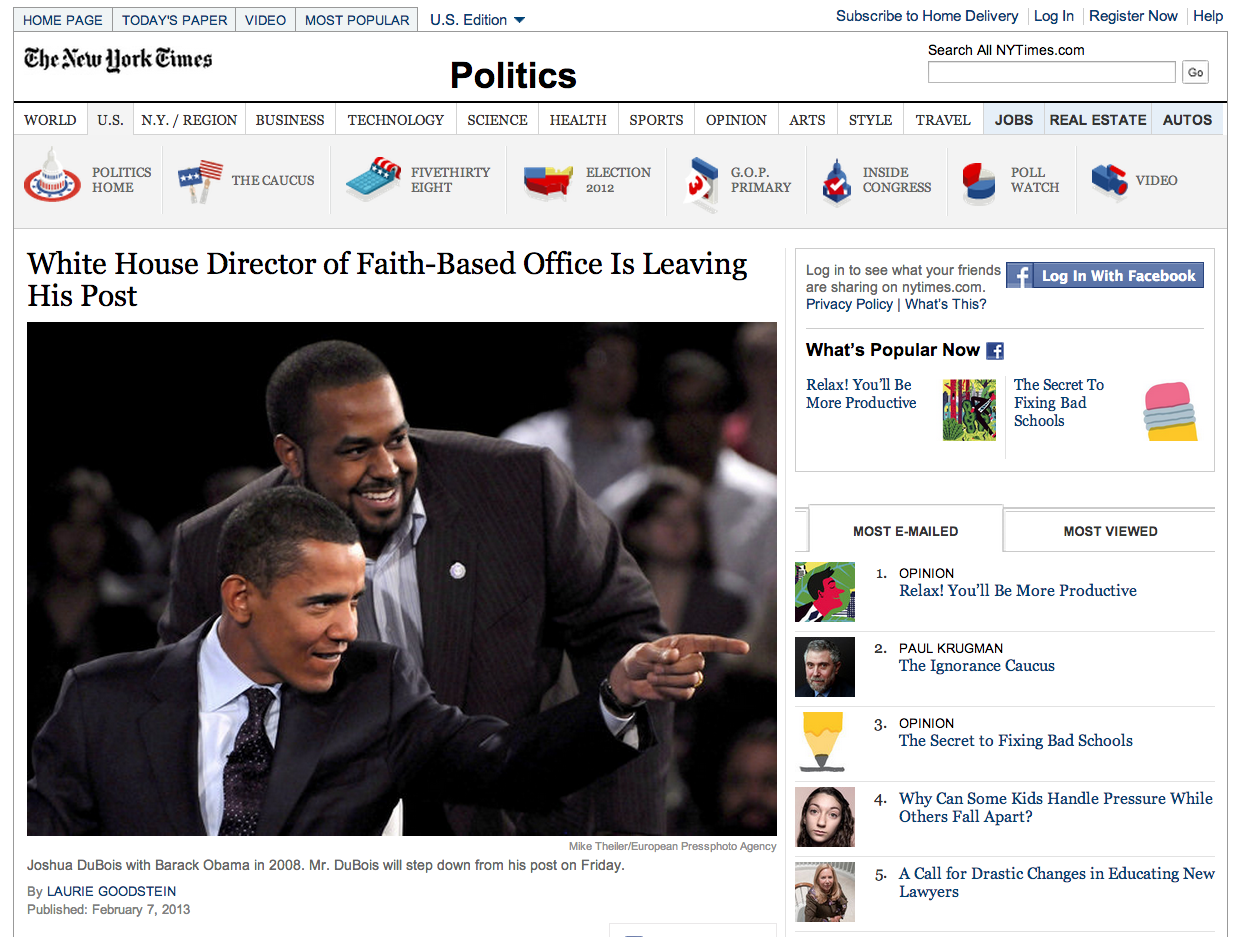
White House Director of Faith-Based Office Is Leaving His Post

Screen Shot 2013-02-11 at 12.39.44 PM President Obama announced on Thursday morning at the National Prayer Breakfast in Washington that Joshua DuBois, the young pastor he appointed four years ago to lead the White House Office of Faith-Based and Neighborhood Partnerships, would step down on Friday.

Mr. DuBois played a central role when Mr. Obama was making his first run for the presidency, cultivating relationships on his behalf with religious leaders of many faiths. Mr. DuBois, 30, has also served as an unofficial in-house pastor to Mr. Obama, sending the president an e-mail each morning with Bible passages intended to prompt reflection or prayer.

At the prayer breakfast, the president called Mr. DuBois a “close friend of mine and yours” who “has been at my side — in work and in prayer — for years now.”

He continued, “Every morning he sends me via e-mail a daily meditation — a snippet of Scripture for me to reflect on. And it has meant the world to me. And despite my pleas, tomorrow will be his last day in the White House.”

The faith-based office was started by President George W. Bush at the beginning of his first term, which proved contentious because many critics said the office and its actions often violated the constitutional separation of church and state. But Mr. Obama preserved the office and appointed advisory councils that represented a broad range of religious leaders, including conservative evangelicals and openly gay ministers.

Mr. DuBois, a black Pentecostal minister, steered the office toward engaging religious leaders to address broad social goals like reducing unwanted pregnancies, helping people cope with the economic downturn, encouraging fathers to take responsibility for their children and improving child and maternal health.

Some of the most prickly First Amendment issues facing the faith-based office were never resolved under Mr. DuBois’s tenure, most notably the question of whether religious organizations can receive government funding and still discriminate in hiring. The office last year released a report that did not propose definitive policies.

A White House official said that Mr. DuBois planned to teach at New York University, and would create an organization to help government, nonprofit and private institutions develop partnerships with religious groups to solve social problems. He will work with Michael Wear, his former assistant and the director of faith outreach for Mr. Obama’s second presidential campaign.

With Mr. Obama’s blessing, Mr. DuBois will also write a book of devotionals for leaders, based on those he sent to the president.

The Rev. Joel C. Hunter, the senior pastor of Northland, a network of churches based in Longwood, Fla., said that he observed significant changes in the faith-based office after Mr. Obama inherited it from Mr. Bush.

“Before it was basically about which organizations got funded,” said Mr. Hunter, who served on the first faith-based advisory council appointed by Mr. Obama. He said that Mr. DuBois focused on connecting religious leaders with policy makers, adding, “What has resulted is this accessibility to policy conversations by faith communities that really wasn’t there before.”

But the Rev. Barry W. Lynn, the executive director of Americans United for Separation of Church and State, who served on a task force at the faith-based office, said that Mr. DuBois’s tenure was “a lost opportunity to fix real constitutional problems,” such as government financing of religious organizations that discriminate in hiring or that serve the public in overtly religious settings.

FIND THIS ARTICLE AT: http://www.nytimes.com/2013/02/08/us/politics/white-house-director-of-faith-based-initiatives-will-step-down.html?_r=1&

View Post