Filtering by Category: Reconciliation

  •   Reconciliation   •  

Christian Leaders Respond to 'Literally Satanic' Shooting at Charleston Church; 4,000 Residents Gather for Vigil

Christian Leaders Respond to 'Literally Satanic' Shooting at Charleston Church; 4,000 Residents Gather for Vigil

Christian leaders and organizations condemned the killing of nine African-American men and women at the Bible study of a Charleston church this week, acknowledging the "sin of racism" in America, even as more than 4,000 residents and leaders of different faiths came together for a vigil in the shaken city.

View Post

  •   Reconciliation   •  

As Baltimore Burns, Christian Leaders Get Ready to Put Out the Fire at Reconciled Church Summit in Orlando

As pockets of East and West Baltimore erupted in flames and riot on Monday night over the death of 25-year-old Freddie Gray who died on April 19 after suffering serious injury while in police custody, a diverse coalition of Christian leaders from across the country gathered at First Baptist Orlando church in Florida Tuesday to discuss ways in which the church can intervene and prevent these eruptions before they even start.

View Post

  •   Reconciliation   •  

For pastors, march to racial harmony led pair to 'Selma'

For pastors, march to racial harmony led pair to 'Selma' For pastors, march to racial harmony led pair to 'Selma'

Just as many Americans were celebrating the birth of the Prince of Peace, "Selma" marched into select movie theaters to remind us of a time not so long ago when peace was in short supply.

I experienced "Selma" last month. It blew me away. To say the least, the film captured in a way that is both visceral and instructional not only the Selma-to-Montgomery march for voting rights, but also a thick chapter of our history that is at once shameful and triumphant.

Someone once declared, "Those who cannot remember the past are condemned to repeat it."

The sad corollary is that people without knowledge of the past lack the context needed to understand current events.

That includes the recent attacks on voting and the disdain of protests over the deaths of unarmed black males at the hands of police — who under the protective wing of Jim Crow could brutalize and kill blacks with impunity.

For that, "Selma" offers clarity. Yet, perhaps the greatest service the movie provides — a lesson we desperately must absorb — is that the great unfinished march for civil rights isn't a black thang. It's an American thing.

What better reminder than seeing blacks, whites, Catholics, Jews, Christians and others locked arm in arm like a human charm bracelet walking into the heart of withering oppression at 30 frames per second.

Little did I know that harmonizing sentiment was rebooting here in Central Florida.

A couple of months ago, Joel Hunter received a phone call from Oprah and Joshua DuBois, who formerly ran the Office of Faith Based and Neighborhood Partnerships under President Barack Obama.

They shared a vision of multiracial congregations across the country watching "Selma" together and talking afterward about reconciliation.

Hunter, senior pastor of Northland, A Church Distributed, in Longwood, was sold. Indeed, for Hunter — for whom King's assassination inspired his turn to faith — the chat recalled a resonant failure.

In the Trayvon Martin aftermath, Hunter joined with Sanford Pastors Connecting, a multiracial group that Sanford police credit with helping tamp down simmering tensions. Quartets of pastors haunted the courtroom, prayed throughout the trial and plowed the way for meaningful dialogue in Sanford.

Yet after that initial cultivation, the reality of continuing, intentional interaction withered.

So Hunter phoned the Rev. Paul Wright. His church, Calvary Temple of Praise, hosted the first Sanford Pastors Connected group meeting. Wright relished the notion of joining Hunter's congregation for a march into "Selma."

Police, community leaders and congregants from both churches filled two theaters, some 500-strong.

For two hours, there was a hush as the n-word crashed into viewers' ears and tire irons, barbed-wire-wrapped sticks and billy clubs crashed into marchers' skulls.

When the lights came up, so did the stories.

Blacks of a certain age recalled the brick walls erected as they tried to register to vote in their own Selmas. Others recalled injustices they'd witnessed in Sanford.

"People literally were in tears after the movie, wondering how people could do that to one another," Hunter says. "Even though the mood was very sober, the conversation afterward was very hopeful."

Such success demands duplication. Communities everywhere should crib the idea.

For sure, "Selma" offers a fine opening gambit. However, these conversations to marshal thoughtful discussion and broker understanding and kinship needn't only occur in darkened theaters over hot-buttered popcorn.

"The need for dialogue is obvious because we don't have legal segregation, but we do have de facto segregation, in the way we live and in that most of our conversations are among those who look like us," Hunter says.

"... If we make the effort to talk often enough, have friends not of our race, not of our social groups, that will build a much better community in the future."

Now comes the challenge. Even if the spirit is willing, follow-through can be weak. "Selma" may have revived the conversation. But the connecting can't stop after the credits roll.

[email protected] or 407-420-5095

SOURCE: http://www.orlandosentinel.com/opinion/os-selma-to-sanford-darryl-owens-20150111-column.html

View Post

  •   Reconciliation   •  

Pastors hope film will rekindle racial reconciliation in Sanford

Pastors hope film will rekindle racial reconciliation in Sanford Pastors hope film will rekindle racial reconciliation in Sanford

Black and white pastors are hoping the movie Selma will renew efforts toward racial reconciliation in Sanford that started with the death of Trayvon Martin.

Northland Church Pastor Joel Hunter and Calvary Temple of Praise Pastor Paul Wright say the film, which opens Jan. 9, can restart discussions on the unfinished business of the civil rights movement for blacks and whites.

"What I want to do as a white pastor is to continue to be part of the civil rights movement. This movie gives us a chance to re-engage with each other," Hunter said.

Wright said his congregation discusses issues of race and injustice on a regular basis, but the film brings those conversations out in the open for interracial dialogue.

"I think the black communality wants reconciliation. I believe the white community wants reconciliation. We just have to understand the terms of what is expected," Wright said. "We can't resolve it until we can understand it."

Members of Northland and Calvary Temple will watch the movie together, along with other community leaders and law enforcement, at a special premier on Jan. 6 in Altamonte Springs. The screening will be followed by a discussion.

"This gives us an opportunity going forward not only to discuss the movie, but to discuss our present day issues," Wright said.

The film comes at a time when the deaths of Michael Brown in Ferguson, Mo. and Eric Garner in New York City have exposed the tension and mistrust between blacks and law enforcement. It's the same dynamic that existed in Sanford when George Zimmerman shot and killed Trayvon Martin in 2012.

Sanford escaped the violence that followed the deaths of Brown and Garner in other cities, largely because of the work between the black community and the police department, facilitated by the interracial organization called Sanford Pastors Connecting, said Sanford Police Chief Cecil Smith.

"Sanford went through a bad time, but the leadership and the partnership of the pastors allowed the community to have a voice," Smith said. "Trayvon Martin was a fire that lit our community, but what it also did was allow us to see our deficiencies, not just in the police department or in City Hall, but in all of our communities."

Just as Selma is a reminder of the unfinished business of race relations in the United States, the riots in response to Brown and Garner brings to mind the unfinished business of the Sanford Pastors Connecting, the pastors said.

"We really have not come to the full hopes of that group which was to effect on-going racial reconciliation in Sanford," Hunter said. "The original purpose was to bring the races together to make a healthy community as we go forward into these perilous times."

[email protected] or 407-420-5392

Copyright © 2015, Orlando Sentinel

SOURCE: http://www.orlandosentinel.com/features/religion/os-northland-blacks-and-police-20141231-story.html

View Post

  •   Reconciliation   •  

Crowds recall the faith that animated MLK’s unfinished dream

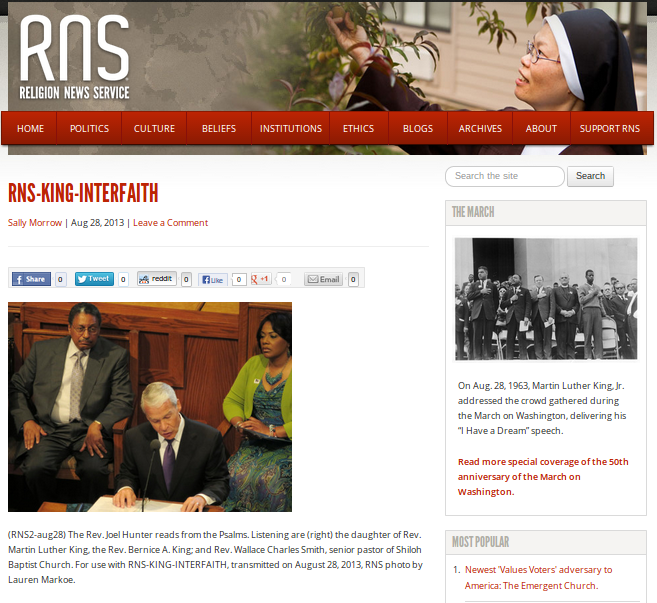
Joel Hunter at MLK 50th Anniversary WASHINGTON (RNS) Fifty years to the day after Martin Luther King Jr. knocked on the nation’s conscience with his dream, religious leaders gathered in a historic church to remind the nation that he was fueled by faith.

Later, in the shadow of the Lincoln Memorial where King thundered about America’s unmet promises, King’s children joined the likes of President Obama and Oprah Winfrey to rekindle what Obama called a “coalition of conscience.”

At Shiloh Baptist Church, where King preached three years before his 1963 “I Have A Dream” speech, Christian, Jewish, Muslim and Sikh clergy summoned King’s prophetic spirit to help reignite the religious fires of the civil rights movement.

King’s daughter, the Rev. Bernice A. King, said at the service that her father was a freedom fighter and a civil rights leader, but his essence was something else.

“He was a pastor,” said King, who was 5 when her father electrified the nation in front of the Lincoln Memorial. “He was a prophet. He was a faith leader.”

“We can never forget as we celebrate, as we remember . . . that it was that faith and the spirit of God itself that fueled, that infused the movement that led to great change and transformation in the 50’s and 60’s.”

The Rev. Raphael Warnock, senior pastor of Martin Luther King’s own spiritual home, Atlanta’s Ebenezer Baptist Church, said they had come together to celebrate a servant of God, “whose ministry stretched far beyond the four walls of the church, and whose parish was America and the world itself.”

Other clergy recalled with pride how members of their own faiths joined with King 50 years ago to non-violently challenge racism and demand equal opportunity and jobs.

Rabbi Julie Schonfeld, executive vice president of the Rabbinical Assembly, read from a letter written to King by Rabbi Abraham Joshua Heschel, who walked shoulder-to-shoulder with him during the freedom march from Selma to Montgomery, Ala. in 1965.

“Even without words, our march was worship,” Heschel wrote. “I felt like my legs were praying.”

Schonfeld said that in the years after the Holocaust, King gave Jews in America a spiritual rebirth, a reason to believe that “God had not forsaken all mankind.”

Born in Sudan, Imam Mohamed Magid, president of the Islamic Society of North America, said King’s legacy made it possible for 28 faith communities came to his mosque after 9/11 to pray alongside his congregation.

King taught that “hate cannot drive out hate,” Magid said. “Only love can do that.”

After the morning prayer service, throngs gathered at the site of King’s speech to mark decades of progress but warn that justice remains elusive for some.

“We’re not here to claim any victory. We’re here to say that the struggle continues,” said Andrew Young, a King aide who went on to become mayor of Atlanta, U.N. ambassador and president of the National Council of Churches. “Pray on and stay on and fight on.”

Added King’s eldest son, Martin Luther King III: “No one ever told any of us that our road would be easy. I know that our God, our God, our God would not bring all of us this far to leave us.”

The Rev. Joseph Lowery, one of the last living icons of the civil rights movement, spoke from a wheelchair close to the imposing statue of Abraham Lincoln and challenged the crowd to battle modern-day efforts to deny rights and restrict freedom.

“We come here to Washington to say we ain’t going back,” said Lowery. “We’ve come too far, marched too long, prayed too hard … bled too profusely and died too young to let anybody turn back the clock on our journey to justice.”

By Lauren Markoe and Adelle M. Banks. Source: http://www.religionnews.com/2013/08/28/crowds-recall-the-faith-that-animated-mlks-unfinished-dream/

View Post

  •   Reconciliation   •  

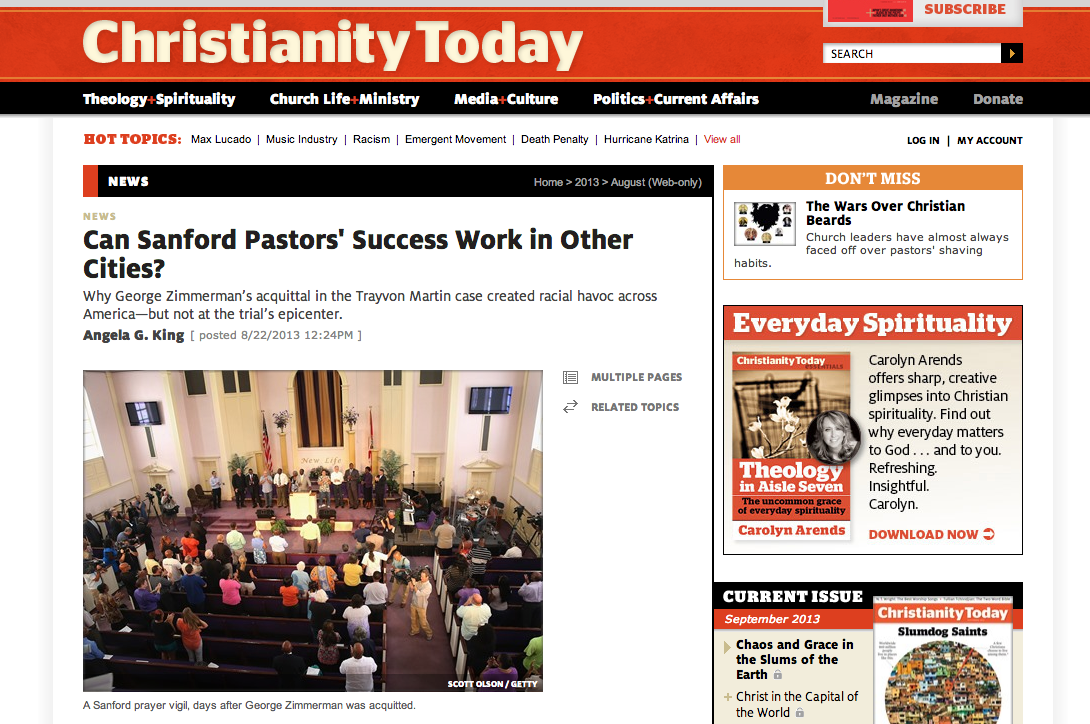
Can Sanford Pastors' Success Work in Other Cities?

Screen Shot 2013-08-29 at 3.47.47 PM A diverse group of 40 pastors gathered in a Detroit hotel today to hear a remarkable tale: how the pastors of Sanford, Florida, spared their city from the racially charged protests that erupted nationwide last month after a jury acquitted George Zimmerman of murdering Trayvon Martin.

Sanford could have understandably been the epicenter of outrage over the controversial July verdict, which inspired significant protests—some marred by vandalism and violence—from New York to Los Angeles. Instead, this commuter suburb of Orlando weathered the aftermath so successfully that its pastors are now on a mission to spread the progress they've made toward calm and reconciliation to urban centers nationwide.

Already on the list after Detroit: Toledo, Charlotte, New York, Denver, and Minneapolis.

"The timing is absolutely right for this. There is no question about it," said Derrick Gay, pastor of Sanford's Dominion International Church and an organizer of the tour. "We as the church have been given, according to 2 Corinthians 5, the ministry of reconciliation. There's no other institution on earth that has been given this authority—not the government, not the banks, not the education system that we have."

The collaboration, in which pastors across racial, ethnic, and denominational lines meet to eat, pray, and candidly air racial concerns, is even more notable in a city with the historical distinction of being where Jackie Robinson was ousted from minor-league baseball training in 1946.

Leading the charge is Sanford Pastors Connecting (SPC), the interracial, cross-denominational group first organized by the United States Department of Justice (DOJ) to help the city of Sanford navigate fallout from the shooting death of unarmed, 17-year-old Martin there in February 2012.

The Department of Justice sent veteran mediator Thomas Battles to Sanford to help keep the peace after Martin's death. He, in turn, organized pastors to form SPC. The pastors were given four reserved seats daily in the local courtroom during Zimmerman's trial. The pastors rotated through to witness the proceedings firsthand and to relay what was going on to courthouse crowds and to their own congregations.

SPC pastors agreed to support the jury's verdict, whatever it was, and keep the peace afterward. When the jury acquitted Zimmerman of second-degree murder and manslaughter charges, it seemed it might be a problematic promise to keep.

But solidarity and prayers played a big part in diffusing any violence that might have broken out in Sanford, either during the initial unrest over Martin's death or when Zimmerman was ultimately acquitted, said Joel Hunter, a SPC member perhaps best known as one of President Barack Obama's spiritual advisors.

"We had already built up a very solid core of people who were committed to not just reacting to a verdict, but sifting through how we could improve the community because of this," said Hunter. His congregation, Northland: A Church Distributed, near Sanford is predominantly white, and is the largest evangelical church in central Florida.

Hunter said that sitting together through the somber, racially charged Zimmerman trial ironically helped to bridge some of the long-entrenched disconnect between Sanford's black and white clergy.

Positioned side by side, chatting before and after court proceedings, and having lunch together during breaks "has built a much closer relationship between many of the African-American pastors and Anglo pastors," said Hunter. "You can say talk is cheap. But when you go through something like this and you have an ongoing dialogue, the closeness of relationships that happens is really remarkable."

Despite their different races, genders, and religious backgrounds, 30 to 40 clergy have continued to meet monthly for breakfast at Sanford's Cracker Barrel restaurant since the start of the trial. That's no small feat, given that getting any group of pastors to work together can be "like herding cats," said Jeffrey Krall. The Assemblies of God pastor chairs SPC alongside pastor Valarie Houston, whose Allen Chapel AME Church is regarded as "Ground Zero" for the public outcry over Martin's death.

Krall, lead pastor of Sanford's mostly white Family Worship Center, said the seeds for this momentum were actually sown 22 years ago.

"It's always been racially divided down here," said Krall of his city's 55,000 residents. (Today, 30 percent are African American, 20 percent are Hispanic, 3 percent are Asian, and the rest are white.) In response, he launched the Sanford Ministers Fellowship in 1991. Though the group has been working to cultivate reconciliation in Sanford a lot longer—and is just as steadfast in praying and interceding toward that end—Krall conceded the fellowship never became as large, high-profile, or diverse as SPC has become over the past year.

"I actually feel like Thomas Battles used his leverage to accomplish what I have been trying to do for more than 20 years," Krall said of the DOJ regional director, who is African American. "I'm rejoicing that he got involved. There's just a great humility and fear of God on everybody."

"That doesn't mean that the issues have all gone away. We have a lot of work cut out for us," said Charles Holt, rector of St. Peter's Episcopal Church and School in neighboring Lake Mary. "But what's changed in Sanford is the communication taking place [between] various churches across the spectrum, and between the church and the community. That's a huge step in the right direction."

Another local Christian leader who has been very ambitious in mobilizing pastors to seek racial reconciliation is Steve Strang, founder and CEO of Charisma Media. From his headquarters in Lake Mary, a city barely more than 2 miles from where Martin died last year, Strang has rallied Sanford-area pastors to hold special prayer meetings and forums in the wake of the shooting.

Last year, his company produced Sanford: The Untold Story, a documentary of Sanford-area church leaders speaking out on race relations. In July, Strang brought together 30 faith leaders from around the country to publicly issue a covenant of racial reconciliation. Called The Sanford Declaration, the July 31 announcement at Charisma Media served as a prelude to the National Reconciliation and Relationship Initiative now being mapped out.

"We invited some pastors from different cities that actually came on their own dime to see what's happening in Sanford," said Gay, who is African American. Attendees included Promise Keepers president Raleigh Washington and such megachurch leaders as Touré Roberts of One Church International in Los Angeles, Dale Bronner of Word of Faith Family Worship Cathedral in greater Atlanta, and Harry Jackson of Hope Christian Church in suburban Washington, D.C. The plan is now for Sanford pastors to visit these urban centers with their message. The first stop: Gay keynoted Promise Keepers' Reviving Detroit Summit today at the struggling city's iconic Hotel St. Regis.

A former star football player at Florida A&M University, Gay has become key among Sanford ministers in pushing for racial reconciliation. In November 2011, he moved his multicultural, nondenominational congregation to the Sanford area from Altamonte Springs.

"It was a tough decision because in the transition, we probably lost a third of our church," said Gay. "However ... as a 34-year-old, for the first time in ministry, I feel like I'm in the right place and God has ordered this thing. ... When everything began to jump off, I really felt strongly that this city needed someone who was not from this city, and could identify with the people there, particularly the young people."

Despite the enthusiasm SPC pastors have for their undertaking, some counter that there's still a long way to go to forge any kind of lasting, substantive advances in race relations in Sanford, let alone nationwide.

There are still "layers and layers of issues" that need to be addressed, said Bridget Watson. Involved with SPC when it first got off the ground but no longer, she and her husband lead Dunamis Community and Outreach Ministries, a small multiracial church near Sanford.

"I have a 17-year-old son and a 14-year-old son, both who are excellent students and very mannerly," said Watson. "We have to teach them to never appear in such a way as to [seem] threatening. I know my white friends don't have to worry about that."

Parris Baker is not a minister, but the charismatic Northland attendee was invited to work with SPC at its onset. However, the 25-year-old African American said he eventually cut ties with the group, frustrated by their steady calls for meetings about reconciliation, healing, and prayer.

"While I appreciated those efforts, they were inadequate," said Baker, a Sanford actor and rap artist who is studying to become a teacher. "As a young man, I am painfully aware of how young people, by and large, are unchurched. Conscious of how deeply I and other young people were affected by Trayvonʼs killing, I knew we needed to be reached, but it could not be accomplished through church or youth conferences."

But SPC wants to go beyond Cracker Barrel meals. After Zimmerman's acquittal, they started prayer meetings at the Sanford police station and issued a joint proclamation for peace. Next they hope to launch a Swap-A-Pulpit Sunday, a monthly youth worship service, and develop sports programs and other after-school activities so that Sanford youth and law enforcement can interact.

Meanwhile, other faith-based groups are also trying to unite the community. Examples include the Love Sanford Project, headed by community activist Paul Benjamin Sr., and a youth mentoring project for inner-city youth that Benjamin's Central Florida Dream Center is developing with St. Peter's.

Krall says he's finally witnessing the manifestation of a breakthrough he got wind of decades years ago. "I was on a fast when the Lord [revealed to] me that he wanted to do something very, very significant in the city of Sanford," he said. The experience led him to create the older Sanford fellowship. "People would actually fly into our little airport to see what God was doing here." He thinks the cooperation could offer a glimpse of heaven a la Revelation 7:9-10, with "a great multitude, which no man could number, of all nations and kindreds and people" praising Jesus.

Gay admits that visions differ a bit between members, just as they differ in other areas. "In all honesty, we may [still] be divided on what we feel justice should be in this situation," he said. "But we're not going to allow this thing to have a negative impact on this city.

"Our feelings were put on the back burner for the sake of this community," he said. "This is the way that we believe Christ would operate, and we've seen tremendous things happen. It is essential for us to now move forward."

By Angela G. King. SOURCE: http://www.christianitytoday.com/ct/2013/august-web-only/sanford-florida-pastors-reconciliation-trayvon-zimmerman.html?paging=off
View Post

  •   Reconciliation   •  

Sanford Pastors Commit to 'Seize the Moment'

More than 15 months ago, pastors from around the country gathered near Sanford, Fla., for a historic meeting to attack the spiritual darkness of racism exacerbated by the tragic death of Trayvon Martin. Wednesday, pastors and national church leaders returned to the area to continue the battle less than three weeks after the acquittal of George Zimmerman. Several local pastors who have been working behind the scenes to tackle the issue of race relations in Sanford were present in the offices of Charisma Media along with Promise Keepers President and CEO Dr. Raleigh Washington and Bishop Harry Jackson, senior pastor of Hope Christian Church and a leader of the High Impact Coalition. Pastors from Ohio, California and Georgia also attended the meeting to help start a racial reconciliation initiative.

Washington said the task of bringing racial harmony and unity to Sanford has only begun, and he reiterated his challenge to spiritual leaders to continue to “cross racial lines” to make it happen.

“You, as the leaders of the church here in Sanford, have the opportunity to seize the moment—the moment to establish genuine relationships that will bring about racial reconciliation here,” Washington said. “Establishing genuine relationships across racial lines are what’s going to make a difference. You cannot fall asleep at the wheel. Seize the moment.”

Derrick Gay, pastor of Dominion Church International in Sanford, said the historical roots of racism are why the separation of races continues today.

“Why don’t we talk? Why do we still have an issue with each other? Why don’t we like each other?” Gay asked. “Simply because of history. The answer is we need anointed leadership in place, where everyone will submit to that leadership. We need to make this a lifetime effort to link arms with each other.”

Joel Hunter, senior pastor of Northland Church, said that tide could be broken.

“The inertia of history can only be interrupted by relationship,” Hunter said. “There’s a difference between justice and law. ... Justice is something that only happens through relationship."

Ron Johnson, pastor of One Church in Longwood, Fla., said, referring to racism, “To break this, it can’t happen by default. It has to happen by design.”

While riots and violent protests broke out in spots around the country in the days following the July 13 not-guilty verdict for Zimmerman, only peaceful protests were staged in Sanford.

“People are going to point to Sanford one day and say, 'These people have learned to do it right,'” Washington said. “You, the leaders, have stayed on the battlefield and continued the challenge we gave you. Other cities simply don’t know how to deal with this issue.”

Sanford Pastors Connecting, a group of pastors formed after the initial meeting in April 2012, have met on a monthly basis and are building initiatives to bridge the racial gap in the community. Jackson said he hopes other communities follow Sanford’s lead.

“You are an example and a model. What would happen if we could replicate the concepts you have put in place here?” Jackson asked. “We must continue to pray prayers that will touch black, white, Asian and Hispanic kids that are losing their way everywhere.”

SOURCE: http://www.charismanews.com/us/40461-raleigh-washington-sanford-pastors-must-seize-the-moment

View Post